Ireland Welcomes Encore Film Screenings of Award-Winning ‘Dalai Lama Renaissance’ Film and its Director Nov 22 – Dec 8
admin | November 11, 2012
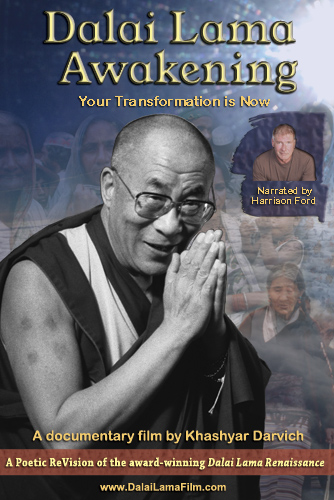
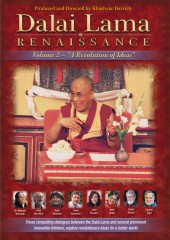
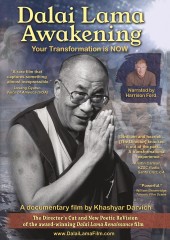
Narrated by actor Harrison Ford, ‘Dalai Lama Renaissance’ attracted sold-out audiences and rave reviews during its first successful 10 city tour of Ireland last July.
DUBLIN – Can an award-winning film that presents the Dalai Lama’s transformational wisdom in action truly change audiences who watch it? How can the Dalai Lama’s message of compassion lead to a “Quantum Leap” from the head to the heart?
After 12 film festival awards, thousands of screenings around the world, and hundreds of inspiring filmmaker Q&A’s, audiences this winter in Ireland will experience those answers for themselves, as the Dalai Lama Renaissance Documentary Film and its director Khashyar Darvich travel to Ireland in November and December 2012 to begin a 2 week Irish screening and Director Q&A tour, after a very successful earlier 10 city tour of Ireland last July.
Because of the success of the previous Irish film screenings, the Irish Government’s film council, Access Cinema, invited Darvich and the film back to Ireland for additional screenings so that more Irish audiences would be able to see and experience the inspiring film and thought-provoking Director Q&A.
Recently appearing on the Irish national Newstalk radio program ‘Shenanigans’ with radio host Sila, Director Darvich commented about his experience with the Dalai Lama, which includes two interviews with the Tibet Spiritual Leader: “The Dalai Lama has a palpable powerful presence that you can feel, whether you are sitting in a room with him, or are in a stadium with 20,000.”
Featuring the Dalai Lama, and narrated by actor Harrison Ford, the film tells the story of 40 Western innovative thinkers who travel to the Himalayan Mountains of India to meet with the Dalai Lama to solve many of the world’s problems. What happened was powerful and unexpected, and was captured by a five camera, 18 person crew.
The film features two of the starring quantum physicists from the hit theatrical documentary What the Bleep Do We Know, Fred Alan Wolf and Amit Goswami. Also appearing in Dalai Lama Renaissance are Michael Beckwith (who appears in The Secret), radio host and author Thom Hartmann, revolutionary social scientist Jean Houston, Vandana Shiva (social activist, The Corporation), and other prominent thinkers.
Amy Wong of LA Yoga Magazine writes: “it is a stunning tour-de-force [and an] intimate glimpse into the Dalai Lama’s life.”
Film Critic John Griffin of the Montreal Gazette calls Dalai Lama Renaissance “a provocative, even enlightening film… fascinating, ravishingly beautiful and sonically soothing.”

Director Khashyar Darvich with a fan if the film 'Dalai Lama Renaissance' after a film screening in Australia
Film Threat Magazine’s Rick Kisonak said Dalai Lama Renaissance is a “comedy sensation,” adding, “I can’t remember the last time a movie made me laugh so hard.”
Audiences around the world have shared that the film screening and Q&A by Director Khashyar Darvich is more like a transformational event than just a film screening.
“Be prepared to leave the Dalai Lama Renaissance event a different person than when you first arrived,” commented Debbie from a screening during the film’s Australian’s tour. “I was thoroughly inspired by both the film and Khashyar Darvich’s Q&A.”
“I look forward to returning to Ireland,” says Director Khashyar Darvich, “to share the film with Irish audiences, as well as speaking with them about the inner journey of personal transformation, in the presence of the Dalai Lama, that was captured in the film.”
The previous July 10-city Irish film and director tour was organized and hosted by Neil Steedman of ‘Tibet House – Young Generation.’ Steedman has also organized events with the Dalai Lama in Ireland during each of the revered Tibetan leader’s Ireland visits.
“The possibility presented of bringing ‘Dalai Lama Renaissance’ and Director Khashyar Darvich for the film’s Dublin premiere… was an opportunity not to be missed,” says Steedman. “The Dalai Lama’s message of universal responsibility, the importance of individual action for inner growth, compassion for all beings, and positivity is one that will resonate with audiences in Dublin and countrywide.”
Dalai Lama Renaissance has screened in cinemas in several countries around the world.

'Dalai Lama Renaissance' has screened in cinemas around the world in several countries, including in over 100 cities in the United States.
The current film tour schedule includes:

Producer-Director Khashyar Darvich answers questions from the audience after a sold-out 800-seat screening of 'Dalai Lama Renaissance'
IRELAND:
- Nov 22 – Naul, Co. Dublin – Venue: The Seamus Ennis Cultural Centre
- Nov 26 – Belmullet, Co. Mayo – Venue: Aras Inis Gluaire
- Nov 27 – Castlebar, Co. Mayo – Venue: Linenhall Arts Centre
- Dec 1 – Dundee (Scotland) – Venue: Nilupul Centre
- Dec 3 – Waterford – Venue: Garter Lane Arts Centre
- Dec 4 – Cork – Venue: University College Cork (UCC) Boole3
- Dec 5 – Bandon, Co. Cork – Venue: Bandon Film Club (Brogans Inn)
- Dec 6 – Clonakilty, Co. Cork – Venue: Clonakilty Film Club (The Park Cinema)
- Dec 8 – Dublin 2 – Venue: The Chester Beatty Library
- Dec 9 – Bantry – Venue: Maritime hotel
(Detailed ticket and venue info is at the bottom of this page)
You may watch the trailer for the film, at: www.DalaiLamaFilm.com, or on the film's Facebook page: www.Facebook.com/DalaiLamaFilm
If you are interested in hosting a film screening and Director Q&A, or know of a cinema or organization that might be interested in hosting a film screening event, please contact Wakan Films at: Bookings (at) DalaiLamaFilm (dot) com.
“Dalai Lama Renaissance” Film Trailer:
No shows booked at the moment.

Viru’s Story: my personal experience in India helping slum children go to school for the cost of one American dinner
Khashyar | September 30, 2011

In this modern world of busy schedules, quick ‘hellos,’ and forgotten promises, there are few life-changing opportunities that we encounter along the way, where we feel that with a little bit of effort, or an amount of money that feels very small to us, that we can profoundly and dramatically make a difference in another person’s life.
When I was in India for 3 months this Spring (2011), in production for my new documentary film entitled ‘Matrix of Compassion,’ I was walking down the dusty streets of Dharamsala, India in the Himalayan mountains, when I was surprised to see a face that I vaguely recognized.
Sitting on the ground on the side of the road, with his portable shoeshine and cobbler supplies positioned on a wooden box and a dusty blanket, and in front of the same hotel where I had stayed 10 years earlier during the filming of my previous ‘Dalai Lama Renaissance’ film, was Viru, a 30-something year old shoe cobbler who had repaired my sandles during that previous first trip to India.
I was surprised to see that he was still there, setting up his portable one-man business in the exact same spot.
His mustache was just as thick, and his hair was just as healthy-looking and bushy (although now a salt and pepper color).
As I looked down onto his face, I was happily surprised that he recognized me as well, and I felt the comfort of meeting a friend again after 10 years.
He offered me a free shoeshine, but I was on my way somewhere, so I thanked him and took a rain-check.
Whenever I would walk down the street past his building-less roadside shoe repair business, he would offer to shine my shoes for free.
After one month of filming for the “Matrix of Compassion” documentary film, I decided that it would be helpful if we added an Indian crew member to the team, and I spent a couple of days reflecting upon who would be the best choice. I wanted to find someone who had a good heart, and who I thought would work hard and was open to receiving direction, and who could learn quickly.
I decided to offer a paying job to Viru as a video cameraman, and I made the commitment to teach him the art and craft of cinematography.
Viru has never used a video camera before in his life, but I imagined that because his shoe-repair work required him to sew carefully and do detailed work with his hands, that he probably had good hand-eye coordination. I also observed that he was one of the most hard-working people I had met in India, and unlike some of the other impoverished Indians I had met, Viru had NEVER asked me for money, even though I knew that he and his family were poor.
I just had a good feeling in my heart about him.
So, I gave Viru one of our video cameras, and had him join our film crew. Each day, after he walked one hour up the mountain from his village to upper Dharamsala, I directed him as to how to use the camera, how to hold it, how to frame a shot, and the types of things to film. And at the end of each day, we would spend one or two hours at a cafe and conduct film-watching sessions to review the footage that he had filmed that day, and offer suggestions as to how to improve his technique.
It was inspiring to see how, through hard work and dedication and sheer effort, Viru’s camera work became better and better every single day, until after 2 months working on the crew, Viru was the hardest-working member of our film crew, and he shot some of the best and most beautiful video footage that I brought back with me to the U.S. from India.
I could only imagine that if Viru, with his intelligence, character and work-ethic, had the same opportunity that I had to receive an education, what he could have accomplished in his life.
One day, half-way through our 3 month film production, Viru invited me to come to his home in the village where he lived, for dinner, and to meet his family.
I took a taxi with Viru for the 30 minute drive down the monkey-filled and windy roads of the rocky mountain-side, to lower Dharamsala, towards his village.
Driving around a curve in the road, I saw his village, nestled on an elbow of land that no one else wanted: a haggard hodgepodge of black plastic tents, that looked like they could be blown away by a strong wind.
As I walked down the dirt path inside his village, through groups of black plastic tents and naked children who were not wearing shoes, I was somehow surprised to see that Viru’s house was the same: a one room bamboo frame hut covered with black plastic as the walls, with a fire pit inside for cooking, and no running water nor electricity.
When they needed to use the toilet, they walked down a path to a rocky exposed stream, and did what they needed to do there, then washed themselves in the stream water, and walked back.
I was told later that if every person in the world used toilet paper, then there would not be any trees standing.
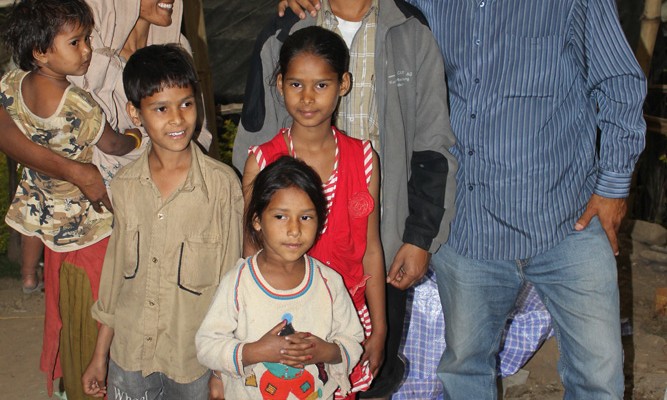
As I met his family, I learned that Viru had 4 children, ages 12, 10, 6 and 2, and that none of them had EVER been to school.
They could not read nor write, nor could they speak English.
But they were such good kids, with sincere smiles and good-hearted faces. I could see: like father, like children. Viru’s wife was also a wonderful person, dedicated to her children and family, as she cooked her family’s Indian food over their fire, and washed their clothes in the same river that their village used for a toilet.
When there was work, Viru’s wife would accept a job collecting bottles and other recyclables for a local recycling company.
I knew that Viru and his family perhaps made a total of 100 rupees per day (less than $3 US dollars).
I wanted to experience, feel and know how Viru’s family lived, so I decided to stay in their village for 3 days. I lived in their black plastic tent house, ate what they ate (which was some of the best India food I ever had), slept where they slept, and yes, I went to the bathroom where they went to the bathroom.
That first time walking to the river was difficult
But after I did what I needed to do, it wasn’t so bad, and I realized that we in the U.S. and in more developed countries, have SO much. We are so wealthy and fortunate, even if we don’t own a house, or are millionaires.
Nearly all of us have enough food. We have shelter. We have indoor toilets. We are not in danger of starving.
Viru told me that there was days when they did not have enough money to buy food, and on those days, his children did not eat.
But, THEY did have something that many Americans did not: the realization that THINGS do not bring us happiness. Happiness comes from within, as well as what we share with our family and friends.
Happiness does NOT come from material things, or possessions, or… cars or money or status. It comes from who we are.
And then, one evening, my heart told me that aside from the calling I felt to make this documentary film about personal and spiritual transformation, that I had something else meaningful and important to do. And that, with what is really very little money for an American, that I can make a huge and life-long difference in the lives of Viru’s children.
I knew on my heart that I had no choice but to act.
This was my chance to make a real difference in the lives of 3 children.
I learned that after the cost of the registration fee for each child (about $75 per child), as well as purchasing school clothes and shoes (about $20 per child), that the cost of sending each child to a decent private school was only about $8 per child per month.
How could I go to a restaurant in my home city of Los Angeles, knowing that for the cost of what I pay for my meal, that I can send 3 children to a good private school for an entire month?
So, I decided to spend $24 per month to send 3 of his school-age children to school, give them an education, and change their lives forever.
It was something that I HAD to do.
If I did not act on this opportunity to make a real and lasting and powerful difference in the lives of these 3 children, then… I would not be able to sleep at night.
So, today, I just sent the money today to register his 3 children to school, to pay for their school clothes and shoes, as well as to cover their first month of tuition fees. I also sent about $45 (2,000 rupees) extra just so his family could buy food or other essentials, and reduce their financial stress for perhaps a month).
Right before I left India, I promised Viru that I would help his children go to school, and I told him that it was important that they received an education. (Viru had to drop out of public school when he was 10, to go work as a shoeshine boy and shoe cobbler, just like his father had done before him).
Because of the succession of poverty in his family, neither Viru, nor his father before him, had the opportunity to break the cycle of needing to work beginning at a small age, and consequently did not receive a basic education so that their lives could be better than the generation before them.
As a child, I took for granted that I went to school every day, that I had clothes and food, that I attended and graduated from High School, that I went to college, and now I am doing something that I really enjoy (Producing and Directing documentary film that have positive and inspiring messages).
Viru cried when I made him this promise to fund his children’s education, and now he calls me his big brother.
I called Viru tonight, and told him that I had sent the money, and Viru again thanked me from a place deep in his heart, in a way that I have been rarely thanked or appreciated or valued before.
It seems unfair that what is so little money for me can make such a huge and momentous difference in the lives of 3 children, whose eyes are so clear and bright, but who were facing a life of poverty and illiteracy, and a lack of hope.
I was blessed that as a result of traveling to India to make a film, that I serendipitously and unexpectedly came across 3 young children who I could easily, directly and personally help. Yes, I could have, from America, sent money to an aid organization that helps to feed children and families. But it is rare that we have the opportunity to directly meet people whose lives we can easily change, and it somehow feels more satisfying that I help this family, and these children, directly.
They know that there is one person in the Western world (that they have only seen in distant images), who cares about them and who wants to help.
If Viru only really knew how much knowing him and his family has changed me, and how helping him has filled my heart with joy, warmth and love, and a deep satisfaction that comes only from make a real difference in the world.
Viru told me that his children felt despair and shame, when they saw some other children in their village go to public school, when, because of a lack of money, they could not.
I saw the pain and the shame on Viru’s face as he answered my question that he wanted to send his children to school and give them a better life, but he couldn’t.
I feel that I have already made a difference in their lives, by simply expressing that someone cares about them. Someone in this big large world that they cannot touch or see from a television that they don’t own, nor on webpages on a computer that they can only dream of using, cares about them and is showing it through action.
Every single person has a way to help others and make the world a little bit better than when they first arrived on the planet.
It is up to us to listen quietly within our hearts, and understand what gift we have to share with others, and then act on that realization.
Khashyar Darvich
Producer-Director
‘Dalai Lama Renaissance’ and ‘Matrix of Compassion’
www.DalaiLamaFilm.com and www.MatrixOfCompassion.com

I received tickets to the Barack Obama Presidential Inauguration
Khashyar | January 10, 2009
Hi Everyone,
I was fortunate enough to receive tickets to attend the January 20th Presidential Inauguration in Washington D.C.
I contacted all three of my Congressional Representatives the morning of the election, and learned in December that I received 2 tickets.
I appreciate the opportunity to attend this historic moment.
Because I thought that I might receive tickets, our “Dalai Lama Renaissance” team began scheduling screenings of the film in Ohio and Pennsylvania, so that I could combine work, seeing my family (who live in Washington D.C. and Maryland), and attending the inauguration.
I will try to take some video and post it.
Khashyar Darvich
Producer-Director
“Dalai Lama Renaissance”

“The Quantum Activist” Documentary Film (about Amit Goswami)
Khashyar | January 1, 2009
Hello Everyone,
There is a new documentary about Amit Goswami that is very close to being released entitled “The Quantum Activist.”
It looks like a very interesting film that takes an in-depth look in the Amit’s work as a Quantum Physicist, as he bridges the gap between quantum physics and spirituality.
The official website for ”The Quantum Activist” Documentary film is here: http://quantumactivist.com/
And Amit Goswami’s Official Website: http://www.amitgoswami.org/
Here is the trailer for “The Quantum Activist”:
“The Quantum Activist” looks very interesting and worth watching.
Khashyar Darvich
www.DalaiLamaFilm.com

Dalai Lama reference by Bill Murray in the 1980 film “Caddyshack”
Khashyar | January 1, 2009
The first major popular film reference to the Dalai Lama that I could find is from the 1980 Bill Murray film, Caddyshack.
In the film, Murray plays golf course groundskeeper Carl Spackler at the Bushwood Country Club:
“So I jump ship in Hong Kong and make my way over to Tibet, and I get on as a looper at a course over in the Himalayas….So, I tell them I’m a pro jock, and who do you think they give me? The Dalai Lama, himself. Twelfth son of the Lama. The flowing robes, the grace, bald… striking.
So, I’m on the first tee with him. I give him the driver. He hauls off and whacks one – big hitter, the Lama – long, into a ten-thousand foot crevasse, right at the base of this glacier. Do you know what the Lama says? Gunga galunga… gunga, gunga-galunga.
So we finish the eighteenth and he’s gonna stiff me. And I say, ‘Hey, Lama, hey, how about a little something, you know, for the effort, you know.’ And he says, ‘Oh, uh, there won’t be any money, but when you die, on your deathbed, you will receive total consciousness.’ So I got that goin’ for me, which is nice.”
Khashyar Darvich
www.DalaiLamaFilm.com

How to Meditate (my experience with meditation)
Khashyar | December 31, 2008
Hello Everyone,
Sometimes I have conversations with my friends and others about meditation, and the powerful benefits that it brings.
For me, it is a way to connect and tap into a deep bedrock source of tranquility, well-being, clear guidance and happiness. Mediation also helps me receive clarity regarding a question or decision I need to make, or an idea I need clarity about.
I have been meditating (on and off) since 1988, when I first discovered meditation during a trip to Colorado during a college Christmas vacation.
At the time, I was feeling profoundly unhappy, and didn’t know why or how to change how I was feeling.
So, as often happens when someone feels unhappy, I began to search for clarity and happiness.
That was my first trip to Colorado, and I found it to be a bright effervencent place, and hope started to flower within me.
My friend took me to a spiritual bookstore, and I was exposed to a variety of different ideas, including Spiritual Yoga and meditation. I discovered a book called “How to Meditate” by Lawrence LeShan, which gives a good practical guide to different forms of meditation from various religious and spiritual traditions, including Christian meditation.
I believe that the technique of meditation is fairly basic and easy to understand, but like balancing on one foot or playing the guitar, but it takes practice and discipline, one day at a time, to receive the most benefit and to truly understand what medition is.
It is like an orange: someone can tell you what an orange is by descibing it to you with words (it is the color orange, round, tastes sweet and tangy, etc.), but that you can’t truly understand it unless you taste it and experience it for yourself.
Here are the basic steps of how I meditate:
1) I sit comfortably with my eyes closed. It is good to wear loose-fitting clothes, so that you feel as comfortable as possible. You can sit on the floor, or in a chair, but try to avoid laying down because it will remind you of sleeping and you might doze off
.
2) My personal technique (which is practiced by some meditation practitioners) is that I touch my thumb and middle finger together, but that is not necessary. The touching of the thumb and finger act as a physiological trigger that more easily brings about a meditative state (like Pavlov’s dogs that start to drool when a bell is rung, because Pavlov successfully associated the ringing of a bell with tasty food – that is, food that a dog finds tasty).
3) Put your attention on one thing. This is often called “one-pointedness. The Dalai Lama and others will tell you that meditation essentially is putting your awareness or attention to one thing, so that you receive deeper and more profound insight of that one thing. That one object of meditation can be an image in your mind’s eye, one word or phrase that you repeat in the quiet of your mind, paying attention to a physical point in your body like the observation of your breathing. The object of your meditation can also be an idea, thought or “problem” that you want to receive greater understanding of. Some people verbally chant a word or phrase, or peform a meditative dance, or even put their attention on a candle or their physical body while they are walking. But, for beginners, it is often recommeded that you meditate with your eyes closed, and choose an object of meditation that feels right to you.
4) When you notice that your attention has wondered from the object of your meditation (for example, you start thinking about the bills that you have to pay, or a noise that you hear outside of your window, or your phone starts to ring
), then gently bring your attention back to the object of meditation that chose.
5) Repeat steps 3 and 4.
Soon, you will find that you are traveling deeper into your consciousness, spirit or mind, and that you begin to have more control of your mind, rather than your unrestrained mind, thoughts and emotions having control over you.
In recent years, the object of meditation for me has been a place very deep within my consciousness.
During the past 3 months, I have felt drawn to direct my awareness to my “heart center,” i.e. in the center of my chest at the same level of my heart. In this way, I am made aware of how my heart feels, and whether my heart feels warm and open.
When I first started meditating, I placed my awareness on my breath, and just was aware of my breath moving in and out.
There are moments in my meditation when I receive profound wisdom and clarity about my life, or peace and tranquility when I have felt a stress or worry.
It acts as a compass or gyroscope that keeps me on my highest path, and towards my goal of serving Humanity and others in the best possible way.
Khashyar Darvich
Producer-Director
“Dalai Lama Renaissance”
www.DalaiLamaFilm.com