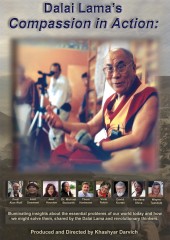
15 percent discount image for the Dalai Lama Renaissance film DVD


Dalai Lama – Washington D.C. – Schedule, Tickets – Mind and Life Conference

Mind and Life Conference in Washington, DC, USA on October 8 & 9: His Holiness will participate in a Mind and Life Conference on the theme of Educating World Citizens in the 21st Century. The conference will feature educators, scientists and contemplatives discussing issues on Cultivating a Healthy Mind, Brain and Heart to be held at the DAR Constitution Hall.

Contact Website: www.educatingworldcitizens.org

Speakers and Panelists

Speakers

Tenzin Gyatso – The XIV Dalai Lama

Marian Wright Edelman, J.D. – Children’s Defense Fund

Richard J. Davidson, Ph.D. – University of Wisconsin – Madison

Linda Lantieri, M.A. – Inner Resilience Program

R. Adam Engle, J.D., M.B.A. – Mind and Life Institute

Jacquelynne S. Eccles, Ph.D. – University of Michigan

Panelists

Peter L. Benson, Ph.D. – Search Institute

Martin Brokenleg, Ph.D. – Vancouver Institute of Theology

Ronald E. Dahl, M.D. – University of Pittsburgh

Linda Darling-Hammond, Ed.D. – Stanford University School of Education

Nancy Eisenberg, Ph.D. – Arizona State University

Mark Greenberg, Ph.D. – Pennsylvania State University

Takao Hensch, Ph.D. – Harvard University

Anne Carolyn Klein / Rigzin Drolma, Ph.D. – Rice University

Kathleen McCartney, Ph.D. – Harvard School of Education

Matthieu Ricard, Ph.D. – Shechen Monastery

Lee S. Shulman, Ph.D. – Carnegie Foundation for the Advancement of Teaching

Conference Overview

Session Title

Date

Time

Introduction and Welcome Thursday, October 8 9:00–9:15am
Session One:
Envisioning the World Citizen
Thursday, October 8 9:15am–12pm
Session Two:
Attention, Emotional Regulation, and Learning

Thursday, October 8

2:00–4:30pm
Session Three:
Compassion and Empathy

Friday, October 9

9:30am–12pm
Session Four:
Integrations, Reflections, and Future Directions

Friday, October 9

2:00–4:30pm

Session Descriptions

Introduction and Welcome
Thursday, October 8, 2009 • 9:00–9:15am

R. Adam Engle, J.D., M.B.A.
CEO and Chairman, Mind and Life Institute

Jacquelynne S. Eccles, Ph.D.
University of Michigan

Session One: Envisioning the World Citizen
Thursday, October 8, 2009 • 9:15am–12pm

Speakers

HH Dalai Lama
Marian Wright Edelman, J.D.

Panelists

Matthieu Ricard, Ph.D.
Linda Darling-Hammond, Ed.D.
Jacquelynne S. Eccles, Ph.D.

Moderator

Daniel Goleman, Ph.D.

Interpreter
Thupten Jinpa, Ph.D.

Self-regulation—the ability to be aware of our attention and emotions, and to direct them consciously – enables the mind to focus in ways that support academic learning and positive social relationships. Self-regulation enables us to make conscious choices in response both to our outer experiences and to the feelings and thoughts they engender within us. The habits of mind and heart that are involved in regulating attention and emotion are the foundation of the ‘self-knowledge’ and insight that are among the classical aims of education. These habits are also essential for cooperation and responsible moral conduct as a community member, as well as for personal resilience in the face of adversity.

As neuroscience probes the brain’s executive functions that control attention and emotion, we are beginning to understand how malleable these mechanisms are. Self-regulation is a learnable skill as well as a prerequisite for other forms of learning. Beyond the common-sense observation that better attention in the classroom leads to better learning, practices that hone mindful awareness and focused attention may also foster critical thinking, deeper comprehension, and meta-cognitive skills associated with learning how to learn. We are beginning also to understand the brain mechanisms that link early experiences of either stress or nurturing care, to later emotional health and self-regulation, and to identify developmentally sensitive periods of growth.

Recent programs in SEL have shown impressive results in teaching children techniques for emotional regulation in social interactions. Meanwhile, neuroscientists have been studying contemplative practices that hone attention and emotional regulation in adults. The evidence from adult studies is compelling, and suggests that, with insight from developmental neuroscience and psychology, practices such as those found in the contemplative traditions like mindfulness meditation may also cultivate, strengthen, and extend the habits of mind and heart that SEL teaches.

In laying the groundwork for collaborative research projects to explore such possibilities, the dialogue participants in this session will consider how a variety of pedagogical practices, contemplative and otherwise, may be effective in fostering self-regulation among parents, educators and students; how ethical values form an essential part of the use of contemplative practices in this regard; and how important issues remain about how best to introduce contemplative practices in culturally- and developmentally appropriate ways. Developmental issues are especially important here: from earliest childhood, when self-regulation creates a stable and safe space for cognitive learning, through adolescence, when self-regulatory capacities can creatively and productively channel the energy unleashed in puberty; to adulthood where one continues to refine such skills and brings them into the world in more prominent ways with children and youth (e.g., in schools).

Back to Top

Session Three: Compassion and Empathy
Friday, October 9, 2009 • 9:30am–12pm

Speaker

Linda Lantieri, M.A.

Panelists

HH Dalai Lama
Peter Benson, Ph.D.
Martin Brokenleg, Ph.D. Nancy Eisenberg, Ph.D. Matthieu Ricard, Ph.D.

Compassion and empathy are fundamental to moral and character development and to any vision of a kinder, more just, and more caring society and world. Complex emotions that embody an awareness of one’s interconnection with others, compassion and empathy serve as a foundation for altruism, cooperation, helping, and other prosocial behavior. The Dalai Lama notes that human beings have a natural propensity for compassion and empathy but “need specialized training” to extend this feeling beyond the immediate circle of family, friends, and others we identify with closely. A key challenge in educating world citizens is expanding this circle of concern to encompass the wider, interdependent world in all its diversity. Educational strategies that aim to build respect for diversity may be most effective when focused both on the value and experience of such diversity, as well as on deep commonalities in the human experience that transcend culture (e.g., the desire of happiness).

Contemplative traditions have approached compassion as a learnable skill that ideally develops into an enduring positive quality, transforming our automatic response to the world from a reactive and self-centered mode to a more reflective and other-centered mode. The cultivation of compassion, empathy, and other virtuous emotions is traditionally taught through a rich, culturally embedded repertoire of reflective and cognitive techniques, as well as role modeling. Is it possible to extract the core wisdom of these practices from their religious and cultural origins without disempowering them; and if so, may they offer a valuable resource for the aims of moral and character education in secular societal contexts like schools? What are the elements of school culture which would have to change to realize these benefits?

Contemplative practices that cultivate compassion and empathy may also support cognitive learning and help young people to discover meaningful purpose in their lives and passionate engagement in their immediate and far-reaching communities. Such practices could complement, or be integrated into, on-going curricular and instructional efforts aimed at teaching students about civic engagement, social justice, ethical responsibility, and moral decision-making in deep, enduring, and transformative ways. Research on brain processes underlying prejudice and intolerance suggests that contemplative practices that improve attention and emotional regulation can also bring prejudice into conscious awareness and thus offer a fulcrum for change. Other studies have examined factors that determine how empathy for the suffering of others may transform into compassionate, helping behavior rather than overwhelming sadness or fear. Collaboration between educators, scientists, and contemplatives on issues such as these could bring us closer to new understandings of how best to educate the compassionate heart in developmentally appropriate ways.

Back to Top

Session Four: Integrations, Reflections, and Future Directions
Friday, October 9, 2009 • 2:00–4:30pm

Panelists

HH Dalai Lama
Takao Hensch, Ph.D.
Lee Shulman, Ph.D.
Linda Darling-Hammond, Ed.D.

Moderator

Roshi Joan Halifax,

Interpreter

Thupten Jinpa, Ph.D.

This final session will offer reflections on the previous two days of dialogue and will serve to integrate and explore new ideas that have been sparked by the process. For example, participants in the final session will discuss windows of opportunity in which the developing brain is optimally receptive for the cultivation of particular mental qualities associated with attention, emotion, empathy and compassion that have been discussed in the meeting. They will also discuss the institutional and social contexts of schools today that could facilitate or hinder efforts to introduce contemplative practices in K-16 education. Furthermore, the question of how the introduction of contemplative practices in formal educational settings could complement, expand upon or reframe contemporary educational reform efforts at these various levels, to the extent such practices are adapted for public education settings in culturally sensitive, developmentally appropriate and thoroughly secular ways will also be discussed.

The overarching aim of this session is to develop a set of tractable scientific questions regarding the use of contemplative practices in educational contexts that can be researched in the near future, and that ultimately may inform educational practice and policy in ways that benefit teachers, students, and their families. As just one example, consider a key principle in the contemplative traditions – the importance of embodiment. Embodiment refers to our ability to “give form through our verbal and non-verbal behavior” to certain cherished qualities, for instance, kindness to others. In this context, one hypothesis is that the embodiment of qualities like compassion, empathy, and mindfulness in adults and older peers is a powerful form of social role modeling that teaches the young important lessons about how to become a responsible member of a family, a peer group, a school, a community and a society. For students to learn the skills needed for world citizenship and personal responsibility in the 21st century world, one hypothesis is that if these qualities are to be successfully developed in students, teachers must model such skills and behaviors themselves in a school context that is supportive of such skills and behaviors at all levels. That is, teacher embodiment of these skills, as well as a supportive school environment, really matter for students’ motivation and capacity to learn and embody such qualities themselves. From this perspective, a key priority in this work going forward is to inquire into how teacher training and direct service programs on compassion and mindfulness for teachers and parents may form a necessary, but not sufficient condition for the cultivation of these qualities in young people. In addition, such work will need to address issues of context: How can school leaders support the cultivation of positive habits of the mind and heart in the whole school culture? How can educational leaders design and implement “mindful and compassionate communities of learning” for students, teachers, parents and educational leaders alike?

Ultimately, we envision an education system in which young people are recognized and educated as cognitive and emotional, ethical, and social beings whose lives are deeply interconnected with others; one that lifts their spirits and engages them fully in active, meaningful learning, and that cultivates the positive qualities necessary to be a caring and contributing member of the world community in the coming years The world’s contemplative traditions are a precious resource that can contribute to the education and development of people who are compassionate, ethically responsible, and in control of their mental lives and who, as a result, are positioned optimally to meet the extraordinary political, social, and spiritual challenges of our time

Contact Website: www.educatingworldcitizens.org

Share this with your friends and family:


Comments

Leave a Reply

You must be logged in to post a comment.