Om Cumbia Om: The Liberating Message of the Dalai Lama Finds Deep Global Resonance on the Dalai Lama Renaissance Soundtrack
Khashyar | May 17, 2010
Om Cumbia Om: The Liberating Message of the Dalai Lama Finds Deep Global Resonance on the Dalai Lama Renaissance Soundtrack
There’s a sanctuary where the pulse of cumbia moves to Tibetan notions of eternal time, where Native American and Indian sonics transform the voice of a female Sufi from Iran. A retreat where one of the planet’s most revered teachers’ words become a melody, and the message dances in the medium.
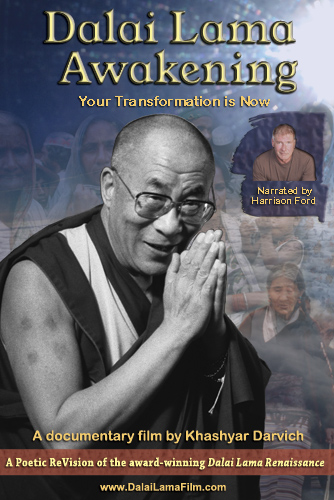
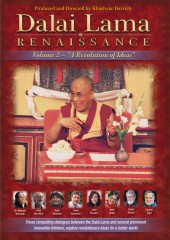
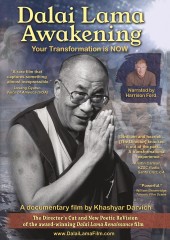
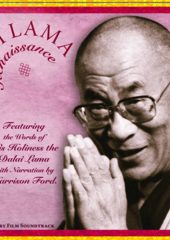
This place, created in a cozy home studio in the L.A. hills, is the home of the striking soundtrack to the documentary film Dalai Lama Renaissance (White Swan; May 11, 2010). The film follows the journey of some of the world’s most distinctive thinkers—from nuclear physicists to self-help experts, with narration by actor Harrison Ford—to see the Dalai Lama at his Indian home-in-exile and discuss a way to freedom for Tibet and humanity. The release is timed with the Dalai Lama’s May 12-23 speaking tour of the United States. The soundtrack flows from the voluntary contribution of a diverse yet serendipitously harmonious group of musical fellow travelers brought together by percussionist and producer Michel Tyabji.
Tyabji set out to accomplish the impossible: the creation of a score and soundtrack for a feature-length film worthy of the subject matter, without a budget. Yet this very hindrance proved to be the project’s strength. “The most affirming thing about this project was that it attracted certain types of people,” Tyabji notes, recalling how artists came out of the cyberspace woodwork wanting to advance the Dalai Lama’s message. “No one had any money but we didn’t have a firm schedule, either. We had time.”
With that time, musicians could come and linger in Tyabji’s home studio over cup after cup of tea, letting their inspiration carry them. Or Tyabji could meet them wherever they happened to be in the L.A. area, as he did with Grammy-winning guitarist Larry Mitchell. They connected at a nearby hotel where, on the fly, Mitchell effortlessly laid down a solo on Tyabji’s thumbdrive.
The musicians drawn to the project were a seemingly motley crew: Composer Medicine Bear, who provided large portions of original score; a group of brothers cum classical Indian musicians recruited by an American keyboard player (The Yoginis) and recorded at a rented New Delhi TV station; Heyraneh, a rare female Sufi vocalist from Tehran; and the multitalented Techung, a Tibetan born in exile and trained in traditional Tibetan lhamo opera.
Despite the great spread of sounds and cultures, as Tyabji worked on the tracks and unified them to support the film, he was pleasantly surprised. “I was actually shocked how easily things gelled: traditional Indian, underneath or on top of Afro-Cuban beats, blended with a Tibetan song on the computer,” Tyabji reflects. “We didn’t have to do any fancy stuff. It just came together in a perfect match up of tracks.”
Pieces like “Yar,” where the original plan to record Heyraneh singing a Zoroastrian prayer passed down through Tyabji’s Parsi family turned a magical corner when the singer burst into a Sufi invocation, transforming the track. Or the unexpected “Om Cumbia Om,” where Techung’s expansive recitation of a Buddhist mantra with its own sense of time ended up meshing with an intense Afro-Latin rhythm whipped up by two Colombian percussionist friends.
Even older projects—like a recording Tyabji and his wife and frequent collaborator Rosa had made of the last living teacher of Tibetan chöd chants—worked seamlessly with the material his new-found friends were laying down in the studio. “Rosa and I had recorded Lama Wangdu Rinpoche at an ashram near Portland, Oregon,” recalls Tyabji. “It became an album for use by his students, with really limited distribution. But then it took on a new life as I brought it into the mix.”
Yet the lucky accidents channeling the eclecticism of Dalai Lama Renaissance had deep roots: the calls for peace, freedom, and compassion of the Dalai Lama himself. Though of a different faith, Tyabji felt a profound resonance with His Holiness’ teachings. Descended from a distinguished family including a vocalist favored by Gandhi and a dedicated politician who shaped India’s constitution, Tyabji’s elders instilled a love of wise teachers and the non-violent path to liberation.
He soon learned for himself how music could play a part in that liberation. Tyabji came of age traveling the world with his parents, UN workers who took on some of the world’s most difficult assignments. One of these challenging postings took the family to Somalia, where a teenage Tyabji watched the desperately poor country slip into a devastating civil war.
“I saw that music and poetry held together whatever semblance of society was left,” he muses. “Just having a battery-powered walkman saved us. There was something that made a little bit of sense. There was certainty in the beat, the lyrics. That’s when I got into music, in Africa, and understood its power.”
This power to move, encourage, and heal, Tyabji feels, also lies in the words and voice of the Dalai Lama, which he interwove throughout the soundtrack album. The task of picking and choosing the words seemed daunting at first—until he began to hear the music in His Holiness’ message. After spending years trying to find the right fit with the music, Tyabji discovered to his surprise that the passages that he felt most strongly were the ones where the tone and cadence meshed best.
“For me, his most powerful message, the one that repeats on the album like a mantra, is that each of us is personally responsible to think about humanity, other human beings,” Tyabji states. “For someone who has lived in so many different countries, who’s lived through wars, who was fortunate to be born into a family that cares, I know this is what we all need to think about: each other.”
The accidental meetings and fortunate breaks involved in the making of the album are still bearing fruit. Tyabji has teamed up with Techung and their tours have taken them as far away as European Russia’s oft-overlooked Buddhist region, Kalmykia. Heyraneh’s participation in the project has moved her out of the margins, where she was relegated due to her gender, and into the local spotlight, as the L.A. Persian community embraces her artistry.
Tyabji senses that this joint effort based on a mutual love for the Dalai Lama’s message is like one of the Tibetan songs Techung brought to the project, “Lhasang.” The singer calls out to the mountains, hoping to hear what the echoes may bring. “That song embodies what we were doing with this album,” Tyabji smiles. “We were singing out to a stone wall and just waiting to hear what happens.”

Semshae-Heart Songs CD Release Tour – Tibet CD, featuring Tashi Shazur (Techung) released to help Tibetan children learn their language
Khashyar | May 17, 2010
Semshae-Heart Songs CD Release Tour
Website: http://www.semshae.org
The new Semshae-Heart Songs album is comprised of contemporary and traditional Tibetan songs composed especially to help children learn some basic vocabulary of the Tibetan language. The songs teach the Tibetan numbers, colors, days of the week, and seasons, and convey cultural information about daily chores, visiting a temple, gardens, musical instruments, and peace. The CD notes provide the song lyrics in Tibetan script, phonetic Tibetan, and English translation, so children of any cultural background can sing along. The primary goal of this charming album is to ensure that Tibet’s language and culture of compassion are preserved through children’s music for all ages.
Semshae-Heart Songs will be officially released in New York City at Tibet House on May 22, 2010. The release is scheduled in conjunction with His Holiness the Dalai Lama’s visit. The first copy will be offered to His Holiness to receive His blessing. Project founder and director, Tashi D. Sharzur (a.k.a Techung) will then conduct a CD Release Tour to introduce the CD to Tibetan communities in North America, Europe and Asia. Tashi’s tour schedule can be viewed by clicking “Upcoming Events” on Semshae’s website (http://www.semshae.org).
Tibetan Association of Southern California will organize the CD release party and community fundraising event on June 12 from 6-9p.m. to help their Sunday School education project. Tashi and the local Tibetan community children will sing songs from the new album, and he will be available to sign CDs. This event will take place at IBEW 8333 Airport Blvd, LA CA 90045. The cover charge is $20.00 Children under 16 free. For more info about the Tibetan community visit www.socaltibet.org
Many individuals are aware of Tibetan Buddhism’s culture of compassion and nonviolence, but they may not be aware that the continued existence of Tibetan culture is seriously threatened. Through music, Semshae – a non-political, privately funded project— contributes to the preservation of a part of Tibet’s culture and its dissemination around the world.
Semshae-Heart Songs will also be a welcome addition to the small library of Tibetan music for the many Westerners who are interested in Tibet and Tibetan culture. Exposing non-Tibetan children to the language and culture of a nation whose spiritual belief system emphasizes the happiness and well being of each human can be of benefit to today’s computer/cell phone-driven generation. This is the first album of its kind produced professionally in the West or anywhere in the Tibetan exile community.
Tashi Sharzur is a Tibetan traditional/contemporary singer who grew up in Tibetan refugee camps in Dharamsala, India and now lives with his daughters in the Bay Area, California. His parents followed the Dalai Lama into exile after the Communist invasion of his native country, Tibet, in 1959. His parents and many thousands of refugees searching for work and better life were hired by Indian government to build roads across the Himalayan region. Tashi, like many other children, was born in these makeshift refugee camps at a very difficult time. As Tibetan refugees gradually settled in India, the exiled Tibetan government, with guidance and support from Indian Government, built schools and monasteries. Tashi was sent to the Tibetan Dance and Drama School to learn music and folklore. After moving to United States to join a theatrical group, he co-founded Chaksampa Tibetan Dance and Opera Company and was the artistic director till 2008. He also worked with the Milarepa Foundation in the 1990s and was involved in organizing its Tibetan Freedom Concerts and grassroots campaigns. He has made 7 albums of folk and contemporary Tibetan music, and recently performed at Carnegie Hall.
“It is my hope that through the efforts of Semshae
and through the power of music I can help to support
the next generation of Tibetans and the Tibetan culture.”
— Tashi Shazur, Artist, Founder, and Director of Semshae

Film Screening – Dalai Lama Renaissance Documentary Film – Collingwood, Ontario Canada – Venue: Gayety Theatre – May 19, 2010
Khashyar | May 11, 2010
Dates of Screening: March 22, 2010
Film being screening: Dalai Lama Renaissance Documentary Film (narrated by Harrison Ford)
Screening Venue: Cinema Aero
Address: 161 Hurontario St., Collingwood, Ontario Canada
Website: http://www.elephantthoughts.com/canadian-educational-programs/be-the-change-film-series/
Contact Phone:
Contact Email:
Additional Details: Producer-Director Khashyar Darvich will be appearing in person to participate in a Q&A with audiences after the screening.