Viru’s Story: my personal experience in India helping slum children go to school for the cost of one American dinner
Khashyar | September 30, 2011

In this modern world of busy schedules, quick ‘hellos,’ and forgotten promises, there are few life-changing opportunities that we encounter along the way, where we feel that with a little bit of effort, or an amount of money that feels very small to us, that we can profoundly and dramatically make a difference in another person’s life.
When I was in India for 3 months this Spring (2011), in production for my new documentary film entitled ‘Matrix of Compassion,’ I was walking down the dusty streets of Dharamsala, India in the Himalayan mountains, when I was surprised to see a face that I vaguely recognized.
Sitting on the ground on the side of the road, with his portable shoeshine and cobbler supplies positioned on a wooden box and a dusty blanket, and in front of the same hotel where I had stayed 10 years earlier during the filming of my previous ‘Dalai Lama Renaissance’ film, was Viru, a 30-something year old shoe cobbler who had repaired my sandles during that previous first trip to India.
I was surprised to see that he was still there, setting up his portable one-man business in the exact same spot.
His mustache was just as thick, and his hair was just as healthy-looking and bushy (although now a salt and pepper color).
As I looked down onto his face, I was happily surprised that he recognized me as well, and I felt the comfort of meeting a friend again after 10 years.
He offered me a free shoeshine, but I was on my way somewhere, so I thanked him and took a rain-check.
Whenever I would walk down the street past his building-less roadside shoe repair business, he would offer to shine my shoes for free.
After one month of filming for the “Matrix of Compassion” documentary film, I decided that it would be helpful if we added an Indian crew member to the team, and I spent a couple of days reflecting upon who would be the best choice. I wanted to find someone who had a good heart, and who I thought would work hard and was open to receiving direction, and who could learn quickly.
I decided to offer a paying job to Viru as a video cameraman, and I made the commitment to teach him the art and craft of cinematography.
Viru has never used a video camera before in his life, but I imagined that because his shoe-repair work required him to sew carefully and do detailed work with his hands, that he probably had good hand-eye coordination. I also observed that he was one of the most hard-working people I had met in India, and unlike some of the other impoverished Indians I had met, Viru had NEVER asked me for money, even though I knew that he and his family were poor.
I just had a good feeling in my heart about him.
So, I gave Viru one of our video cameras, and had him join our film crew. Each day, after he walked one hour up the mountain from his village to upper Dharamsala, I directed him as to how to use the camera, how to hold it, how to frame a shot, and the types of things to film. And at the end of each day, we would spend one or two hours at a cafe and conduct film-watching sessions to review the footage that he had filmed that day, and offer suggestions as to how to improve his technique.
It was inspiring to see how, through hard work and dedication and sheer effort, Viru’s camera work became better and better every single day, until after 2 months working on the crew, Viru was the hardest-working member of our film crew, and he shot some of the best and most beautiful video footage that I brought back with me to the U.S. from India.
I could only imagine that if Viru, with his intelligence, character and work-ethic, had the same opportunity that I had to receive an education, what he could have accomplished in his life.
One day, half-way through our 3 month film production, Viru invited me to come to his home in the village where he lived, for dinner, and to meet his family.
I took a taxi with Viru for the 30 minute drive down the monkey-filled and windy roads of the rocky mountain-side, to lower Dharamsala, towards his village.
Driving around a curve in the road, I saw his village, nestled on an elbow of land that no one else wanted: a haggard hodgepodge of black plastic tents, that looked like they could be blown away by a strong wind.
As I walked down the dirt path inside his village, through groups of black plastic tents and naked children who were not wearing shoes, I was somehow surprised to see that Viru’s house was the same: a one room bamboo frame hut covered with black plastic as the walls, with a fire pit inside for cooking, and no running water nor electricity.
When they needed to use the toilet, they walked down a path to a rocky exposed stream, and did what they needed to do there, then washed themselves in the stream water, and walked back.
I was told later that if every person in the world used toilet paper, then there would not be any trees standing.
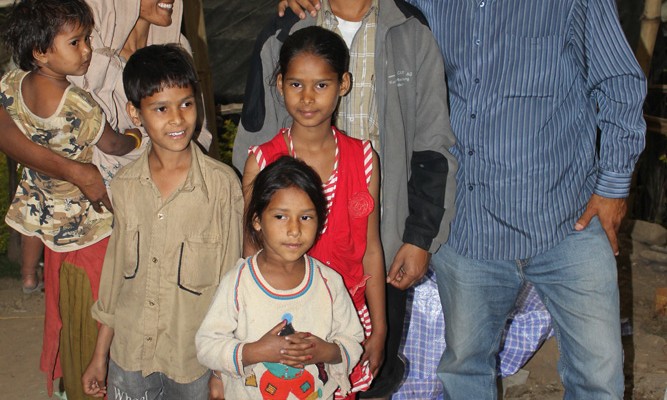
As I met his family, I learned that Viru had 4 children, ages 12, 10, 6 and 2, and that none of them had EVER been to school.
They could not read nor write, nor could they speak English.
But they were such good kids, with sincere smiles and good-hearted faces. I could see: like father, like children. Viru’s wife was also a wonderful person, dedicated to her children and family, as she cooked her family’s Indian food over their fire, and washed their clothes in the same river that their village used for a toilet.
When there was work, Viru’s wife would accept a job collecting bottles and other recyclables for a local recycling company.
I knew that Viru and his family perhaps made a total of 100 rupees per day (less than $3 US dollars).
I wanted to experience, feel and know how Viru’s family lived, so I decided to stay in their village for 3 days. I lived in their black plastic tent house, ate what they ate (which was some of the best India food I ever had), slept where they slept, and yes, I went to the bathroom where they went to the bathroom.
That first time walking to the river was difficult
But after I did what I needed to do, it wasn’t so bad, and I realized that we in the U.S. and in more developed countries, have SO much. We are so wealthy and fortunate, even if we don’t own a house, or are millionaires.
Nearly all of us have enough food. We have shelter. We have indoor toilets. We are not in danger of starving.
Viru told me that there was days when they did not have enough money to buy food, and on those days, his children did not eat.
But, THEY did have something that many Americans did not: the realization that THINGS do not bring us happiness. Happiness comes from within, as well as what we share with our family and friends.
Happiness does NOT come from material things, or possessions, or… cars or money or status. It comes from who we are.
And then, one evening, my heart told me that aside from the calling I felt to make this documentary film about personal and spiritual transformation, that I had something else meaningful and important to do. And that, with what is really very little money for an American, that I can make a huge and life-long difference in the lives of Viru’s children.
I knew on my heart that I had no choice but to act.
This was my chance to make a real difference in the lives of 3 children.
I learned that after the cost of the registration fee for each child (about $75 per child), as well as purchasing school clothes and shoes (about $20 per child), that the cost of sending each child to a decent private school was only about $8 per child per month.
How could I go to a restaurant in my home city of Los Angeles, knowing that for the cost of what I pay for my meal, that I can send 3 children to a good private school for an entire month?
So, I decided to spend $24 per month to send 3 of his school-age children to school, give them an education, and change their lives forever.
It was something that I HAD to do.
If I did not act on this opportunity to make a real and lasting and powerful difference in the lives of these 3 children, then… I would not be able to sleep at night.
So, today, I just sent the money today to register his 3 children to school, to pay for their school clothes and shoes, as well as to cover their first month of tuition fees. I also sent about $45 (2,000 rupees) extra just so his family could buy food or other essentials, and reduce their financial stress for perhaps a month).
Right before I left India, I promised Viru that I would help his children go to school, and I told him that it was important that they received an education. (Viru had to drop out of public school when he was 10, to go work as a shoeshine boy and shoe cobbler, just like his father had done before him).
Because of the succession of poverty in his family, neither Viru, nor his father before him, had the opportunity to break the cycle of needing to work beginning at a small age, and consequently did not receive a basic education so that their lives could be better than the generation before them.
As a child, I took for granted that I went to school every day, that I had clothes and food, that I attended and graduated from High School, that I went to college, and now I am doing something that I really enjoy (Producing and Directing documentary film that have positive and inspiring messages).
Viru cried when I made him this promise to fund his children’s education, and now he calls me his big brother.
I called Viru tonight, and told him that I had sent the money, and Viru again thanked me from a place deep in his heart, in a way that I have been rarely thanked or appreciated or valued before.
It seems unfair that what is so little money for me can make such a huge and momentous difference in the lives of 3 children, whose eyes are so clear and bright, but who were facing a life of poverty and illiteracy, and a lack of hope.
I was blessed that as a result of traveling to India to make a film, that I serendipitously and unexpectedly came across 3 young children who I could easily, directly and personally help. Yes, I could have, from America, sent money to an aid organization that helps to feed children and families. But it is rare that we have the opportunity to directly meet people whose lives we can easily change, and it somehow feels more satisfying that I help this family, and these children, directly.
They know that there is one person in the Western world (that they have only seen in distant images), who cares about them and who wants to help.
If Viru only really knew how much knowing him and his family has changed me, and how helping him has filled my heart with joy, warmth and love, and a deep satisfaction that comes only from make a real difference in the world.
Viru told me that his children felt despair and shame, when they saw some other children in their village go to public school, when, because of a lack of money, they could not.
I saw the pain and the shame on Viru’s face as he answered my question that he wanted to send his children to school and give them a better life, but he couldn’t.
I feel that I have already made a difference in their lives, by simply expressing that someone cares about them. Someone in this big large world that they cannot touch or see from a television that they don’t own, nor on webpages on a computer that they can only dream of using, cares about them and is showing it through action.
Every single person has a way to help others and make the world a little bit better than when they first arrived on the planet.
It is up to us to listen quietly within our hearts, and understand what gift we have to share with others, and then act on that realization.
Khashyar Darvich
Producer-Director
‘Dalai Lama Renaissance’ and ‘Matrix of Compassion’
www.DalaiLamaFilm.com and www.MatrixOfCompassion.com

Prestigious Italian Magazine “FilmTV” calls the Dalai Lama Renaissance film “Illuminating”
Khashyar | September 30, 2011

ROME, ITALY – In a recent film review, the prestigious Italian film magazine ‘FilmTV’ called the ‘Dalai Lama Renaissance’ documentary film “an Illuminating document,” in a Spring 2011 issue of their magazine.
They describe the personal transformation that occurs in the film as being “the journey of a group of eminent scholars and writers to the place of spiritual leadership in India [which] becomes a metaphor for a journey within oneself.”
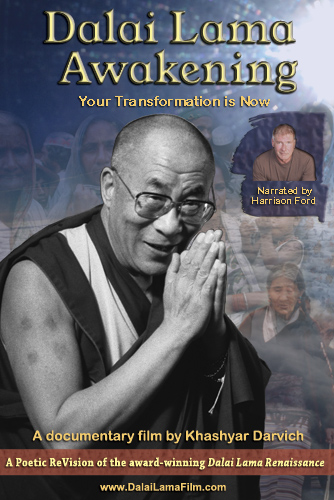
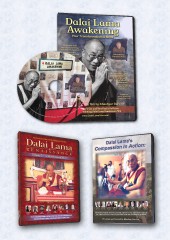
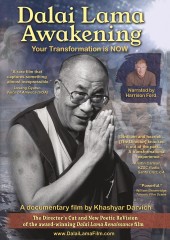
‘Dalai Lama Renaissance’ (which is narrated by Harrison Ford) was released with Italian subtitles in Italy in the Spring of 2011, and has been released in several other countries and languages, including in German, Dutch, Portuguese, Spanish, Chinese, English and other languages.
It is the winner of 12 awards, and is the official selection of over 40 international film festivals.
Bob Graham of the ‘San Francisco Bay Times’ calls the film “an extraordinary portrait of His Holiness at work… [the film includes] some of the best comic scenes in any new film out there right now.”
The DVD of ‘Dalai Lama Renaissance’ is available on the film’s website: www.DalaiLamaFilm.com
The Italian release of the film includes a booklet with interviews with Director Khashyar Darvich and other information.
The following is the Italian and English text of the FilmTV review:
ENGLISH (Google Translation):
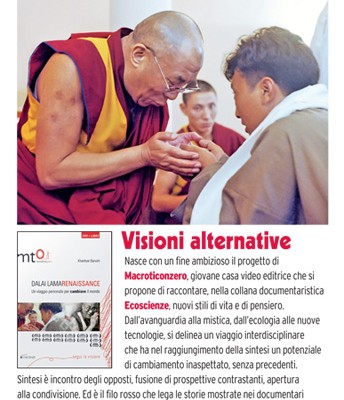
Alternative Visions
Born with a purpose ambitious project Macroticonzero young home video publisher that aims to tell, in the series documentary conscious, new styles of life and thought.
Garde to the mystical, from ecology to new technologies, it outlines an interdisciplinary journey in achieving the synthesis has the potential for unexpected change, unprecedented.
Synthesis is an encounter of opposites, the fusion of contrasting perspectives, openness to sharing. It is the thread that ties the stories shown in the documentary Macroticonzero. As in Dalai Lama Renaissance, where the journey of a group of eminent scholars and writers to the place of spiritual leadership in India becomes a metaphor for a journey within oneself, one’s own culture and their faith. The result is a confrontation / clash between selfishness and narrowness of vision “Western” requires the involvement of Eastern wisdom, the irony of a man able to experience a genuine feeling of compassion for their fellow humans, making them rediscover the disruptive revolutionary charge. And the real antidote to the conditions of existential malaise that go under the name of greed, fear and indifference, becomes the change in perspective, the ability to go beyond the mere sphere of the individual to feel part of humanity that becomes a whole, real synthesis of its constituent parts. A document illuminating.
*****
ITALIAN Language:
Visioni Alternative
Nasce con un fine ambizioso il progetto di Macroticonzero, giovane casa video editrice che si propone di raccontare, nella collana documentaristica Ecoscienze, nuovi stili di vita e di pensiero.
Dall’avanguardia alla mistica, dall’ecologia alle nuove tecnologie, si delinea un viaggio interdisciplinare che ha nel raggiungimento della sintesi un potenziale di cambiamento inaspettato, senza precedenti.
Sintesi è incontro degli opposti, fusione di prospettive contrastanti, apertura alla condivisione. Ed è il filo rosso che lega le storie mostrate nei documentari di Macroticonzero. Come in Dalai Lama Renaissance, dove il viaggio di un gruppo di eminenti studiosi e letterati verso la sede della guida spirituale in India diventa metafora di un viaggio all’interno di se stessi, della propria cultura e della propria fede. Ne deriva un confronto/scontro che tra egoismi e ristrettezza di visioni “all’occidentale” necessita dell’intervento della saggezza orientale, dell’ironia di un uomo in grado di provare un genuino sentimento di compassione per i propri simili, facendone riscoprire la dirompente carica rivoluzionaria. E il vero antidoto alle condizioni di malessere esistenziale che vanno sotto il nome di avidità, paura e indifferenza diventa il mutamento di prospettiva, la capacità di andare oltre la mera sfera individuale per sentirsi parte di un’umanità che diventa un tutto, reale sintesi delle parti che la costituiscono. Un documento illuminante.

Film Screening – Dalai Lama Renaissance Film – Brussels, Belgium – Venue: Institue Nalanda – October 14, 2011
admin | September 29, 2011
Dates of Screening: October 14, 2011
Film being screening: Dalai Lama Renaissance Documentary Film (French subtitled version)
Screening Venue: Institue Nalanda
Address: Institue Nalanda, 50 Rue de l’Orme, Brussels, Belgium 1030
Website: http://www.institut-tibetain.org/
Contact Phone: +32 475363730
Additional Details: Screening of Dalai Lama Renaissance Film (Vol 1). Screening Venue: Institue Nalanda, 50 Rue de l’Orme, Brussels, Belgium 1030; Contact Name: Ada Sekirin; Contact Email: nalanda (att) tibinst (dott) org; Screening Sponsor: Institue Nalanda
Sponsoring Organization: Institue Nalanda

Dalai Lama Renaissance film soundtrack musician, Techung, to perform in Pasadena, CA on Sept 24
Khashyar | September 22, 2011

One of the very talented Tibetan musicians who contributed to the music soundtrack of 'Dalai Lama Renaissance,' will be performing in Pasadena, CA on Sept 24, at a historic "100 Thousand Poets for Change" event.
To whom it may concern,
On September 24th, 2011 is the first annual Historic Global Event – 100 Thousand Poets for Change currently with 600 events happening in 450 cities and 95 countries. I am writing to let the Tibetan community know, through Tibetan radio and media outlets, of the 100 Thousand Poets for Change Tibet Awareness Event in Pasadena, California on Saturday, September 24th. Techung, a renowned Tibetan musician who has opened for His Holiness the Dalai Lama, Sherap Wangmo, and Michel Tyabi will be performing their music at the event. Poetry by influential Tibetan poets Tsoltim N. Shakabpa, Tenzin Tsundue, Tsering Dhompa, Jigme Dorjee DAGYAP, and Woeser will be read at the event. Los Angeles Friends of Tibet will also be at the event distributing information to raise awareness.
We are happy to provide moral support for the Tibetan community around the world and inside of Tibet through the event. I am writing to set up interviews for Techung la to talk about this historic event and the world movement of poets, musicians, and artists to raise awareness for a free Tibet.
Here is the homepage for 100 Thousand Poets for Change http://www.bigbridge.org/100thousandpoetsforchange/
Here is the page for the Pasadena Event http://www.bigbridge.org/100thousandpoetsforchange/?p=112
I am looking forward to hearing from you.
Best wishes,
Teresa Chuc Dowell
100 Thousand Poets for Change
Organizer/Poet/Teacher
Teresa.dowell (at) goddard (dot) edu
*****
100 Thousand Poets for Change: Tibet Awareness Event, Pasadena, CA
The event will take place on Saturday, September 24, 2011 at Zona Rosa Caffe (15 South El Molino Avenue, Pasadena, CA 91101) from 11:30 a.m. to 2:30 p.m. and from 5:30 p.m. to 8:30 p.m. There will be poetry readings, open mic, discussions, music, art, and much more! http://www.zonarosacaffe.com/ 100 Thousand Poets for Change event homepage www.100TPC.ORG
Pasadena event page http://www.bigbridge.org/100thousandpoetsforchange/?p=112 The 100 Thousand Poets for Change Tibet Awareness Event will focus on human rights, freeing Tibet, and the plight of the Tibetan people. To raise awareness, there will be discussions, poetry readings, Tibetan art, music, Tibetan Buddhism, open mic, and speakers. Poems by Tenzin Tsundue, a Tibetan poet/writer/activist who lives in Dharmasala, will be read by others at the event. Poems by Tsoltim N. Shakabpa, a recognized Tibetan poet/activist living in Los Angeles, will be read by others at the event. Due to a recent stroke, Mr. Shakabpa can not make it to the event. Tsoltim N. Shakabpa is a recognized Tibetan poet and a dedicated political activist for a free Tibet. He is the son of Tsepon Wabgchuk Deden Shakabpa, the eminent Tibetan historian, statesman, freedom fighter and former Finance Minister of independent Tibet. Poems from Tibetan poetess Tsering Dhompa’s new book, My rice tastes like the lake, will be read by others at the event. Poems by Tibetan poet Jigme Dorjee DAGYAP, who lives in Gangtok, Sikkim, will be read at the event. Poems from Woeser’s new book Tibet’s True Heart will be read at the event. Tibetan musician, singer/songwriter, Techung, who has opened for His Holiness the Dalai Lama’s public speeches in Costa Rica, Japan, and the U.S., will be performing at the event. Tibetan musician and dancer, Sherap Wangmo Sangpo, and Tibetan musician Michel Tyabi will also be performing. There will also be a Buddhist prayer/chanting for peace. Om mani padme hum.
Join us for this historic event!
Contact Teresa at: Teresa.dowell (at) goddard (dot) edu for more information.

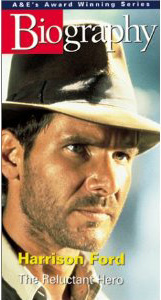
Dalai Lama Renaissance Film to be Highlighted in A&E TV Network’s ‘Biography’ Program about actor Harrison Ford
Khashyar | September 17, 2011
Dalai Lama Renaissance Film to be Highlighted in A&E TV Network’s ‘Biography’ Program about actor Harrison Ford
The ‘Biography’ TV episode will air in several international markets around the world, and will feature the fact that Harrison Ford narrated the Dalai Lama Renaissance documentary film (www.DalaiLamaFilm.com).

The 'Dalai Lama Renaissance' Documentary Film, which is narrated by actor Harrison Ford, will be highlighted in A&E TV Network's 'Biography' program about the actor
NEW YORK – Dalai Lama Renaissance, the award-winning documentary film narrated by actor Harrison Ford and featuring the 14th Dalai Lama, will be highlighted in the Arts and Entertainment TV Network’s ‘Biography’ program about the life and career of the legendary actor.
“I narrated Dalai Lama Renaissance,” says Harrison Ford, “because I believe His Holiness is making a positive influence in our world. For me, the film represented an opportunity to continue assisting the optimistic efforts of an extraordinary individual.”
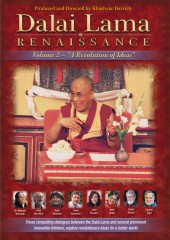
The Dalai Lama Renaissance film (www.DalaiLamaFilm.com), produced and directed by Khashyar Darvich, won 12 awards, was the official selection of over 40 international film festivals, and screened in hundreds of cinemas around the world, including in over 100 cities in the United States. The DVD of the film, as well as the follow-up DVD, Dalai Lama Renaissance Vol 2: A Revolution of Ideas, are now available on the film’s website.
Featuring the Dalai Lama, Dalai Lama Renaissance tells the story of 40 Western innovative thinkers who travel to the Himalayan Mountains of India to meet with the Dalai Lama to solve many of the world’s problems. What happened was powerful and unexpected, and was captured by a five camera, 18 person crew.
After one of Darvich’s interviews with the Dalai Lama, the Dalai Lama affirmed Darvich’s motivations in producing films: “Yes I like your questions,” the Dalai Lama told Darvich, as the two were standing together talking after the interview. “Certainly, your effort can make some contribution—there’s no doubt.”
Dalai Lama Renaissance is only among a small handful of documentaries that Harrison Ford has chosen to narrate during his career. Ford has starred in such blockbuster films as Raiders of the Lost Ark & the Indiana Jones movies, Star Wars, The Fugitive, Witness, and many others. Harrison Ford’s films have one of the highest combined worldwide box office grosses (over $5.5 billion) of any actor in history.
The film features two of the starring quantum physicists from the hit theatrical documentary What the Bleep Do We Know, Fred Alan Wolf and Amit Goswami. Also appearing in Dalai Lama Renaissance are Michael Beckwith (who appears in The Secret), radio host and author Thom Hartmann, revolutionary social scientist Jean Houston, Vandana Shiva (social activist, The Corporation), and other prominent thinkers.
Harrison Ford has previously expressed his support for the Dalai Lama and the cause of Tibetan Independence. In 1995, Harrison Ford spoke before the U.S. Senate Foreign Relations Committee, and testified that: “The Tibetan struggle is no ordinary freedom struggle. The courageous men and women in Tibet have chosen the path laid out by their leader, His Holiness the Dalai Lama. It is a path of non-violence– a path that too few peoples around the world have dared to try… As an American who cares deeply about justice, freedom and democracy, I can tell you that this is a cause that touches at the core of our own values.”
Films starring such big name stars as Richard Gere and Sharon Stone were boycotted by China after the actors expressed support for the Tibet Independence Movement. After Disney released Kundun, Martin Scorsese’s 1997 feature film about the Dalai Lama, the studio incurred the wrath of the Chinese government, and Disney films were banned for an indefinite period of time.
Ford’s former wife, screenwriter Melissa Mathison, wrote the screenplay for Kundun.
The Chinese Government took notice when Dalai Lama Renaissance was released theatrically in Taiwan in the Chinese language and received front page positive press in Taiwanese newspapers.
The People’s Daily, a daily newspaper and media arm of the Central Committee of the Communist Party of China, quickly and sharply criticized Dalai Lama Renaissance, writing that the film describes “the Chinese government’s peaceful liberation of Tibet as ‘cruel oppression,’ [and] …what these movies depict is just the ‘anesthesia’ given by the Dalai Lama to the West.”
In contrast, Taiwanese newspapers gave the film rave reviews. The Taipei Times wrote that “the film rapidly grabs hold of you… an insightful documentary.”
On the front page of the Taiwanese The Liberty Times, Harrison Ford was called a ‘Hero’ for narrating the documentary.
Film Critic John Griffin of the Montreal Gazette calls Dalai Lama Renaissance “a provocative, even enlightening film” and “fascinating, ravishingly beautiful and sonically soothing.”
Amy Wong of LA Yoga Magazine writes: “it is a stunning tour-de-force [and an] intimate glimpse into the Dalai Lama’s life.”
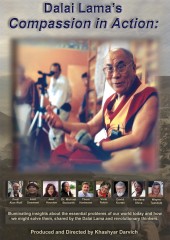
The DVD for Dalai Lama Renaissance, which includes over 105 minutes of additional Special Features, is available now at: www.DalaiLamaFilm.com. The follow-up to the film, entitled Dalai Lama Renaissance Vol 2: A Revolution of Ideas, is also available on DVD.
Director Khashyar Darvich’s new documentary film is The Matrix of Compassion (www.MatrixOfCompassion.com) which features the Dalai Lama, the Karmapa Lama, and others, and is about an inner journey of personal transformation through India, and includes living in an India slum. The Matrix of Compassion will be released in 2012.
The A&E Network, which is jointly owned by the Walt Disney Company, NBCUniversal and the Hearst Corporation, reaches more than 85 million homes in the United States and Canada. A&E’s ‘Biography’ series is broadcast in several languages and countries throughout the world. A&E Television Networks also owns the History Channel and the Biography Channel.