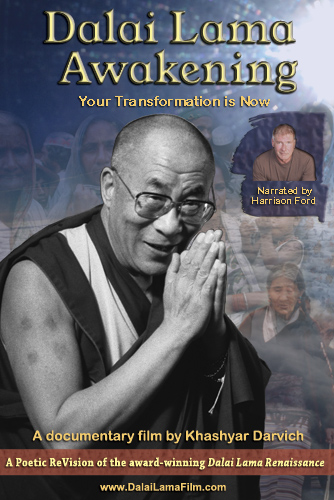
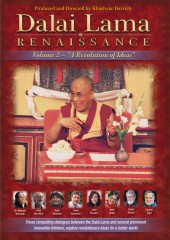
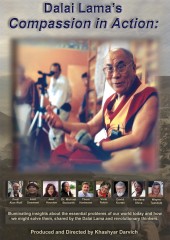
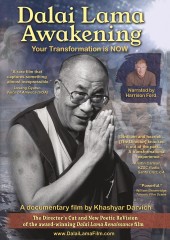
German Language Press reviews of Dalai Lama Renaissance Documentary Film (narrated by Harrison Ford)
Khashyar | July 12, 2010

German language film poster for 'Dalai Lama Renaissance' film. 'Dalai Lama Renaissance' was received very well by German-speaking audiences
German Press Reviews of ‘Dalai Lama Renaissance’ Documentary Film:
It is interesting to read what International newspapers and film critics write about “Dalai Lama Renaissance.”
For example, the major newspapers in Taiwan gave the film overwhelmingly positive reviews:
“The film rapidly grabs hold of you… There is plenty of humor… [a] top-notch comedy… A journey of self-discovery… The lessons of Dalai Lama Renaissance apply just as much to the audience watching this insightful documentary”
- Ian Bartholomew – Taipei Times, Taiwan (review)
***
“A memorable gathering of elites… an inspiring documentary which depicts the Dalai Lama philosophy of peace… Full of meaning… Powerful.”
- Li Zhao Yang – Pots Newspaper, Taiwan
***
“A big spiritual harvest for everyone.”
- Qiu Zu – China Times
***
“No empty seat at the premiere of the documentary ‘Dalai Lama Renaissance… The Taipei premiere has attracted a full house and many people were touched after watching the film.”
- FTV Television, Taiwan
***
“Dalai Lama Renaissance is full of historical significance… [Harrison] Ford’s strong, deep voice adds much color to the documentary”
- Zou Nian Zu – Liberty Times Newspaper, Taiwan
Here are some reviews of “Dalai Lama Renaissance” from major German and Austrian newspapers:
Stuttgarter Nachrichten:
“Freed from their daily academic work, from the comforts and consumerism, thrown into the completely different culture of India, perspectives and thought processes change. The result is an authentic picture of buddhist teachings, to the essence of which the following sentence belongs: ‘Words are bubbles of water, deeds (acts) are drops of gold.”
***
PRISMA Schwaben:
“Dalai Lama Renaissance is a wonderful and fresh perspective of the Dalai Lama and on us in the world who are socially conscious (or care).”
***
Skip.at:
“A fascinating documentary film.”
***
Hamburg PUR:
“A Discussion forum at the highest level”

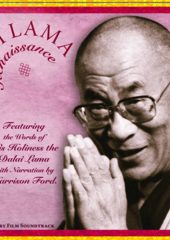
Om Cumbia Om: The Liberating Message of the Dalai Lama Finds Deep Global Resonance on the Dalai Lama Renaissance Soundtrack
Khashyar | May 17, 2010
Om Cumbia Om: The Liberating Message of the Dalai Lama Finds Deep Global Resonance on the Dalai Lama Renaissance Soundtrack
There’s a sanctuary where the pulse of cumbia moves to Tibetan notions of eternal time, where Native American and Indian sonics transform the voice of a female Sufi from Iran. A retreat where one of the planet’s most revered teachers’ words become a melody, and the message dances in the medium.
This place, created in a cozy home studio in the L.A. hills, is the home of the striking soundtrack to the documentary film Dalai Lama Renaissance (White Swan; May 11, 2010). The film follows the journey of some of the world’s most distinctive thinkers—from nuclear physicists to self-help experts, with narration by actor Harrison Ford—to see the Dalai Lama at his Indian home-in-exile and discuss a way to freedom for Tibet and humanity. The release is timed with the Dalai Lama’s May 12-23 speaking tour of the United States. The soundtrack flows from the voluntary contribution of a diverse yet serendipitously harmonious group of musical fellow travelers brought together by percussionist and producer Michel Tyabji.
Tyabji set out to accomplish the impossible: the creation of a score and soundtrack for a feature-length film worthy of the subject matter, without a budget. Yet this very hindrance proved to be the project’s strength. “The most affirming thing about this project was that it attracted certain types of people,” Tyabji notes, recalling how artists came out of the cyberspace woodwork wanting to advance the Dalai Lama’s message. “No one had any money but we didn’t have a firm schedule, either. We had time.”
With that time, musicians could come and linger in Tyabji’s home studio over cup after cup of tea, letting their inspiration carry them. Or Tyabji could meet them wherever they happened to be in the L.A. area, as he did with Grammy-winning guitarist Larry Mitchell. They connected at a nearby hotel where, on the fly, Mitchell effortlessly laid down a solo on Tyabji’s thumbdrive.
The musicians drawn to the project were a seemingly motley crew: Composer Medicine Bear, who provided large portions of original score; a group of brothers cum classical Indian musicians recruited by an American keyboard player (The Yoginis) and recorded at a rented New Delhi TV station; Heyraneh, a rare female Sufi vocalist from Tehran; and the multitalented Techung, a Tibetan born in exile and trained in traditional Tibetan lhamo opera.
Despite the great spread of sounds and cultures, as Tyabji worked on the tracks and unified them to support the film, he was pleasantly surprised. “I was actually shocked how easily things gelled: traditional Indian, underneath or on top of Afro-Cuban beats, blended with a Tibetan song on the computer,” Tyabji reflects. “We didn’t have to do any fancy stuff. It just came together in a perfect match up of tracks.”
Pieces like “Yar,” where the original plan to record Heyraneh singing a Zoroastrian prayer passed down through Tyabji’s Parsi family turned a magical corner when the singer burst into a Sufi invocation, transforming the track. Or the unexpected “Om Cumbia Om,” where Techung’s expansive recitation of a Buddhist mantra with its own sense of time ended up meshing with an intense Afro-Latin rhythm whipped up by two Colombian percussionist friends.
Even older projects—like a recording Tyabji and his wife and frequent collaborator Rosa had made of the last living teacher of Tibetan chöd chants—worked seamlessly with the material his new-found friends were laying down in the studio. “Rosa and I had recorded Lama Wangdu Rinpoche at an ashram near Portland, Oregon,” recalls Tyabji. “It became an album for use by his students, with really limited distribution. But then it took on a new life as I brought it into the mix.”
Yet the lucky accidents channeling the eclecticism of Dalai Lama Renaissance had deep roots: the calls for peace, freedom, and compassion of the Dalai Lama himself. Though of a different faith, Tyabji felt a profound resonance with His Holiness’ teachings. Descended from a distinguished family including a vocalist favored by Gandhi and a dedicated politician who shaped India’s constitution, Tyabji’s elders instilled a love of wise teachers and the non-violent path to liberation.
He soon learned for himself how music could play a part in that liberation. Tyabji came of age traveling the world with his parents, UN workers who took on some of the world’s most difficult assignments. One of these challenging postings took the family to Somalia, where a teenage Tyabji watched the desperately poor country slip into a devastating civil war.
“I saw that music and poetry held together whatever semblance of society was left,” he muses. “Just having a battery-powered walkman saved us. There was something that made a little bit of sense. There was certainty in the beat, the lyrics. That’s when I got into music, in Africa, and understood its power.”
This power to move, encourage, and heal, Tyabji feels, also lies in the words and voice of the Dalai Lama, which he interwove throughout the soundtrack album. The task of picking and choosing the words seemed daunting at first—until he began to hear the music in His Holiness’ message. After spending years trying to find the right fit with the music, Tyabji discovered to his surprise that the passages that he felt most strongly were the ones where the tone and cadence meshed best.
“For me, his most powerful message, the one that repeats on the album like a mantra, is that each of us is personally responsible to think about humanity, other human beings,” Tyabji states. “For someone who has lived in so many different countries, who’s lived through wars, who was fortunate to be born into a family that cares, I know this is what we all need to think about: each other.”
The accidental meetings and fortunate breaks involved in the making of the album are still bearing fruit. Tyabji has teamed up with Techung and their tours have taken them as far away as European Russia’s oft-overlooked Buddhist region, Kalmykia. Heyraneh’s participation in the project has moved her out of the margins, where she was relegated due to her gender, and into the local spotlight, as the L.A. Persian community embraces her artistry.
Tyabji senses that this joint effort based on a mutual love for the Dalai Lama’s message is like one of the Tibetan songs Techung brought to the project, “Lhasang.” The singer calls out to the mountains, hoping to hear what the echoes may bring. “That song embodies what we were doing with this album,” Tyabji smiles. “We were singing out to a stone wall and just waiting to hear what happens.”

Film Screening – Dalai Lama Renaissance Documentary Film – Collingwood, Ontario Canada – Venue: Gayety Theatre – May 19, 2010
Khashyar | May 11, 2010
Dates of Screening: March 22, 2010
Film being screening: Dalai Lama Renaissance Documentary Film (narrated by Harrison Ford)
Screening Venue: Cinema Aero
Address: 161 Hurontario St., Collingwood, Ontario Canada
Website: http://www.elephantthoughts.com/canadian-educational-programs/be-the-change-film-series/
Contact Phone:
Contact Email:
Additional Details: Producer-Director Khashyar Darvich will be appearing in person to participate in a Q&A with audiences after the screening.

Dalai Lama’s U.S. Visits Bring ‘Renaissance’
Khashyar | March 22, 2010
DALAI LAMA’S U.S. VISITS BRING ‘RENAISSANCE’
Those planning the Tibetan spiritual leader’s visits in Florida, California and Iowa also screen the documentary ‘Dalai Lama Renaissance’ (narrated by Harrison Ford – www.DalaiLamaFilm.com) to lay the spiritual groundwork for audiences’ transformation.
March 22, 2010
HOLLYWOOD, CALIF. – Over the last six months, three U.S. visits by Tenzin Gyatso, the spiritual leader and 14th Dalai Lama of Tibetan Buddhism, all have something in common: Their organizers have chosen to screen the award-winning documentary Dalai Lama Renaissance (narrated by Harrison Ford) prior to his arrival.
Before coming to California and Florida earlier this year, organizers of the Dalai Lama’s visits researched films about the spiritual leader. They did so to find a means of telling their communities who the Dalai Lama is and why his message is relevant to their world.
They discovered ‘Dalai Lama Renaissance,’ a documentary film that won 12 international awards and that screened in hundreds of cinemas in the United States and around the world. When ‘Dalai Lama Renaissance’ screened in cinemas in Taiwan in 2009, the Chinese government took notice and aim at the film in its People’s Daily newspaper. In an attempt to help prison inmates resolve inner and outer conflicts through dialog and compassion, the film’s director, Khashyar Darvich, also screened and toured with the film in prisons.
“What we found was a film that was captivating,” said Maria Santamarina, Diversity Officer at Florida Atlantic University in Boca Ratón. “It gave us a personal glimpse of the Dalai Lama and his perspective on the transformation needed in the world right now.” The film screened Feb. 17 and 23, 2010, in anticipation of the Feb. 24 visit by the Dalai Lama.
Santamarina said a colleague referred her to the film, which she found online at DalaiLamaFilm.com. On the other hand, Pema Choden, president of the Tibetan Association of Southern California, first became familiar with Dalai Lama Renaissance when she met the film’s producer/director Khashyar Darvich at a celebration of the Dalai Lama’s 74th birthday.
“I saw the film shortly after meeting Khashyar,” said Choden, “and I felt that it was appropriate to screen during His Holiness’ teachings in Long Beach last September. The film captured the Dalai Lama’s ability to humble people in such a way that no matter who they are, their egos fly out the window.”
Erin Wheat, Program Coordinator for Campus Activities at the University of Northern Iowa, discovered the film online while doing research. She found it in time to plan a screening prior to the Dalai Lama’s May 18, 2010, visit to Cedar Falls.
“We chose to screen Dalai Lama Renaissance because of its content related to His Holiness’ visit in May,” Wheat said. “With so many concerns that people have in our country and in the world – the economy, wars, natural disasters – we felt that his message of peace would set the right tone for his visit,” she said. “We also felt it would be great to have a question and answer session with the producer/director Khashyar Darvich to expand on that message and to share details of how the film was made.”
Santamarina said the Florida screening featured a Q & A with Darvich, who related not only his experiences of shooting the film in remote Dharmsala, India, and editing more than 140 hours of footage, but also told about his personal transformation that took place in the process. She said Darvich spoke of how he meditated and prayed for guidance in editing the film.
“The audience was obviously moved and soulful,” Santamarina said. “There was active participation by the audience members who were extremely engaged, curious and responsive.” Pema Choden had a similar experience with the California screening.
“The response from the audience was extremely gracious,” she said. “Many who attended were so inspired by the film that they wanted to take home a copy on DVD to see it again or to share with loved ones.”
Erin Wheat said she believes that screening Dalai Lama Renaissance and engaging the community in a discussion about the film through a Q & A with Darvich will provide a needed transition for the community toward assurance that spiritual answers and self-reflection can solve many problems.
“This transition will set the stage for the Dalai Lama to present his message of peace and offer his wisdom based on more than 60 years of spiritual leadership,” she said.
Choden added that the film captures the Dalai Lama’s ability to inspire people to be the best human beings that they can be.
“The theme of the film and the teachings of the Dalai Lama are extremely relevant today because both focus on the essence of compassion and altruism,” she said. Maria Santamarina agrees.
“Screening Dalai Lama Renaissance for our community provided a beautiful segue to the Dalai Lama’s visit because the film deals with the transformation of 40 intellectuals who visit with him to discuss changes that need to be made in our world,” she said. “Nothing else could be more relevant and transforming today.”
—
Dalai Lama Renaissance, narrated by Harrison Ford, was produced by Khashyar Darvich and Wakan Films. To view trailers, schedule a screening or to purchase the film on DVD, visit www.DalaiLamaFilm.com.

Film Screening – Dalai Lama Renaissance Documentary Film – Greenville, South Carolina – Venue: Unity Church of Greenville – January 25, 2010 – , 03/07/10
Khashyar | March 5, 2010
Dates of Screening: March 7, 2010
Film being screening: Dalai Lama Renaissance Documentary Film (narrated by Harrison Ford)
Screening Venue: Unity Church of Greenville, SC
Address: 207 E. Belvue Road; Greenville, SC 29687
Website: www.unitychurchofgreenville.org
Contact Phone:
Contact Email:
Additional Details:

Film Screening – Dalai Lama Renaissance Documentary Film – Cedar Falls, Iowa – University of Northern Iowa – Venue: Maucker Union Old Central Ballroom – April 13, 2010
Khashyar | March 5, 2010
Dates of Screening: April 13, 2010
Film being screening: Dalai Lama Renaissance Documentary Film (narrated by Harrison Ford)
Screening Venue: Maucker Union Old Central Ballroom - University of Northern Iowa – Cedar Falls
Address: Cedar Falls, Iowa
Website: TBA
Contact Phone:
Contact Email:
Additional Details: Producer-Director Khashyar Darvich will appear for a Q&A after the screening. Venue Address: Maucker Union Old Central Ballroom 1227 West 27th St Cedar Falls, IA 50614-0167