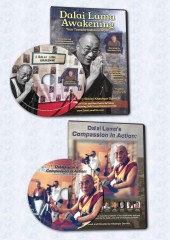
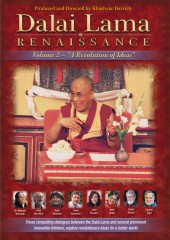
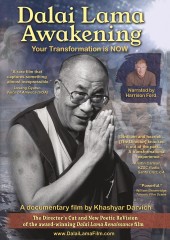
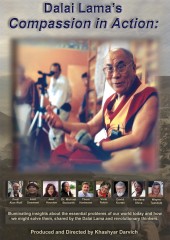
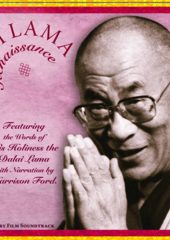
Recent reviews and press for the Dalai Lama Renaissance Documentary Film
Khashyar | August 2, 2009
Recent press review quotes for “Dalai Lama Renaissance”:
“Dalai Lama Renaissance is an interesting portrayal of human ego pitted against compassion and altruism, exemplifying the very essence of the issues facing the world today.” - Todd Mayville, Elephant Journal
“Fire up this DVD and prepare to be amazed… The film has a certain persuasive power… Hilarious.” - Ross Robertson, EnlightenNext Magazine
“A powerful cinematic documentary… A very moving documentary… unexpected and powerful… Long after it ends, the totality of the documentary lingers, as one contemplates the fact that, if every human being decides to act in the best interest of human kind, we can change the world.” -Stan Robinson, Screen Scene/Arizona Weekly
“The film rapidly grabs hold of you… There is plenty of humor… [a] top-notch comedy… A journey of self-discovery… The lessons of Dalai Lama Renaissance apply just as much to the audience watching this insightful documentary” - Ian Bartholomew, Taipei Times
“Saw a great documentary on dvd the other night, ‘Dalai Lama Renaissance.’ If you haven’t seen it, you should.’ - SeriousChedder.com
“A memorable gathering of elites… an inspiring documentary which depicts the Dalai Lama philosophy of peace… Full of meaning… Powerful.” Li Zhao Yang, Pots Newspaper - Taiwan
“A big spiritual harvest for everyone…” - Qiu Zu, China Times, Taiwan
“No empty seat at the premiere of the documentary ‘Dalai Lama Renaissance… The Taipei premiere has attracted a full house and many people were touched after watching the film.” - FTV Television, Taiwan
“Dalai Lama Renaissance is full of historical significance… [Harrison] Ford’s strong, deep voice adds much color to the documentary” - Zou Nian Zu , Liberty Times Newspaper, Taiwan
“HARRISON FORD SKIS WITH THE DALAI LAMA: Harrison Ford, Jackson Hole’s favorite ski son, is riding the chairlift with the Dalai Lama as Harrison is narrating the new film ‘Dalai Lama Renaissance.’ The film premiered in Taiwan and got rave reviews from the Taiwanese Press. China was immediately critical of the film and of the West’s depiction of what has been going on in Tibet. The producer/director Khashyar Darvich has offered to do a screening of the film in China with a question and answer session afterwards. No word on when China offered Khashyar to ski off of steep cliff or to go shush himself in response.” - The Ski Channel Television Network

Harrison Ford Documentary, Dalai Lama Renaissance, Attacked by China’s Communist Party
Khashyar | July 28, 2009

China's Communist Party has attacked the "Dalai Lama Renaissance" Documentary Film
Chinese government reacts to successful theatrical premiere of Dalai Lama film and positive press in Taiwan
Los Angeles, CA (July 29, 2009) - The Chinese government often has the clout and muscle to prevent Hollywood films from being released in Asia, and can even discourage films from having an extended release in the West if they are perceived to threaten Chinese policy.
Films starring such big name stars as Richard Gere and Sharon Stone were boycotted by China after the actors expressed support for the Tibet Independence Movement. After Disney released Kundun, Martin Scorsese’s 1997 feature film about the Dalai Lama, the studio incurred the wrath of the Chinese government, and Disney films were banned for an indefinite period of time.
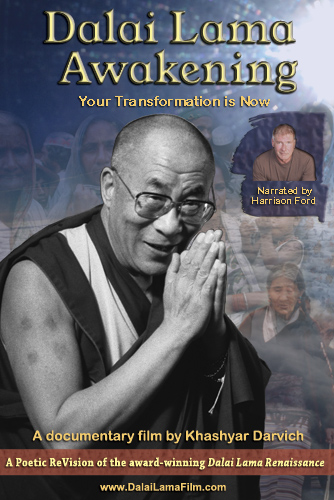
Recently, after a theatrical documentary film about the Dalai Lama and narrated by Harrison Ford entitled Dalai Lama Renaissance (www.DalaiLamaFilm.com) was released in theaters in Taiwan this summer and received front page positive press in the Chinese language Taiwanese newspapers, the Chinese government took keen notice.
The People’s Daily, a daily newspaper and media arm of the Central Committee of the Communist Party of China, quickly and sharply criticized Dalai Lama Renaissance in an article in its online edition.
The article, posted July 14th in the People’s Daily Online entitled “Western Movies Build Grand and Perfect Image of Dalai Lama,” argues that “in recent years, a wave of ‘Dalai Lama fever’ has appeared in the Western movie industry… describing the Chinese government’s peaceful liberation of Tibet as ‘cruel oppression,’ and depicting the Dalai Lama’s life in India as difficult… Some movies even advocate the Dalai Lama’s concept of [Tibetan] ‘independence.’”
Although the title of the article refers to “Movies,” the article exclusively focuses on Dalai Lama Renaissance. Referring to the film, which has been distributed in cinemas around the world, the article criticizes that “the part of the movie related to the peaceful liberation of Tibet was filled with political bias, reflecting the director’s ignorance and misunderstanding of Tibet’s history… The movie transforms the Dalai Lama into an omniscient sage, reflecting a ‘misunderstanding’ of the Dalai Lama’s image in the West… In fact, what these movies depict is just the ‘anesthesia’ given by the Dalai Lama to the West.”
The fact that the Chinese Communist Party’s main media organization has chosen to criticize the film may be a defensive reaction to the very positive press that Dalai Lama Renaissance received in the Chinese language media in Taiwan, where it premiered in front of sold-out audiences on June 1. And it may be an attempt to counteract any effect on readers in mainland China, who often have access to Chinese language news from Taiwan.
Taiwan’s best-selling weekly newspaper, E Weekly, gave the film a rating of 82, which is one of the highest ratings that a film has received in the past year in Taiwan. According to its Taiwanese theatrical distributor, Blockbuster of Taiwan (no relation to Blockbuster video in the United States), E Weekly regularly gives films far lower ratings. FTV, a television station in Taiwan, also reported that that the premiere of the film in Taiwan was very successful, with not an empty seat in the cinema, and that “many people were touched after watching the film.” The Taipei Times wrote that “the film rapidly grabs hold of you… an insightful documentary.”
Ironically, the Chinese Communist Party may feel most threatened by the idea brought up in the film regarding economic sanctions against China from the West. But despite this being a near unanimous suggestion by the Westerners in a scene in Dalai Lama Renaissance, the Dalai Lama discouraged the proposal.
The Taiwanese newspaper The Liberty Times points out that, in the film, “the Dalai Lama thinks that humanity is the most important thing in the world and economic sanctions might affect many Chinese citizens, thus he is hesitant whether such an approach is right.”
The People’s Daily also tries to discredit the producer-director of the film, Khashyar Darvich. In its article, the newspaper claims that the director is a “follower” of the Dalai Lama, and supports this assertion by referring to an interview where Darvich mentioned that he produced the film party for the opportunity to spend time with the exiled Tibetan leader.
“It’s interesting that the Chinese Communist Party refers to me as a follower of the Dalai Lama,” Darvich responded. “Although I respect the Dalai Lama as a man of peace, just as the Nobel Peace Prize Committee did by awarding him the Nobel Peace prize, and as do most governments around the world, I am not a Dalai Lama groupie. When I began the film, I was not very familiar with the Dalai Lama’s ideas. I think that his actions, and the respect that he garners around the world, speaks for itself.”
Despite the Chinese Communist Party’s attempt to discredit the film, Producer-Director Khashyar Darvich states that his production company, Wakan Films, has just signed an agreement to release Dalai Lama Renaissance unofficially into China itself, under the radar of the Chinese Government.
“My hope,” says Darvich, “is that the film will open a dialog between the Chinese government and the Dalai Lama, and that the average Chinese citizen will be able to see that the Dalai Lama is not such a bad guy and is interested in a solution to the Tibet issue that serves the highest good and benefits both the Chinese and Tibetans. I would be happy to attend a screening of the film in China and conduct a Q&A with Chinese audiences as a way to contribute to positive dialog.”
For more information on Dalai Lama Renaissance, go to www.DalaiLamaFilm.com.

Recent news about Techung - the Tibetan musician featured on the Dalai Lama Renaissance sountrack
Khashyar | July 18, 2009
Techung, the Tibetan artist who is the featured musician on the “Dalai Lama Renaissance” soundtrack, has been making much news lately, including embarking on an international tour.
He also has launched his new website: www.techung.com
Here are some recent quotes about Techung from some notable people and in the press:
*******
I had the pleasure of working with Techung, the young Tibetan singer at a recent concert at Carnegie Hall(February 3,2009). He is a highly gifted singer, bursting with talent and personality. I think he is an unusually attractive performer and clearly has the potential to appeal to an audience far beyond the ethnic Tibetan community who already know him quite well. A young man of such talent representing the culture, as it were, of this exiled and oppressed community, could very well have the effect of bringing greater attention to the problems faced by Tibetans living inside and outside of Tibet.
I wish him and those who support him the very best success.
- Philip Glass, March 27, 2009
“Techung” (aka Tashi D. Sharzur) is an exceptional Tibetan musical talent: rigorously trained as an opera “star” by the grand masters of Lhamo, the traditional opera, at the Tibetan Institute of Performing Arts, and with the a life-long background in Tibetan folk music. In recent years, he has written and performed dozens of new songs. While each song appears unmistakably Tibetan and traditional, they are in reality modern compositions with contemporary lyrics, often his own. “Yarlung-Tibetan Songs of Love and Freedom” is an outstanding example of new Tibetan music that will reach a global audience.
- Tenzin N. Tethong
former representative of His Holiness the Dalai Lama and “Kalon Tripa” of the Tibetan Government in Exile.
December 17, 2008
“Tibet musician plays in Taiwan on world tour
FAR FROM HOME: Though he was born outside Tibet, musician Techung has dedicated his life to raising awareness of Tibet’s culture and its political plight …”
May 25, 2008
The Phillippine Star, World Music Under the Stars
“His eyes are as hauntingly serene as his voice, singing of a homeland he has never seen. His call for courage - Nying Thop - cuts through the balmy night air and floats off, carrying the message to his countrymen scattered all over the world: “Never lose courage.”
Techung, a prominent Tibetan singer-songwriter, was one of the most anticipated acts in the recently concluded 2nd Penang World Music Festival, which …”
For complete press information visit: www.sonicbids.com/techung
Videos
http://www.youtube.com/watch?v=HPTgd29adnk
http://www.youtube.com/user/LimitlessSkyRecords
http://http://www.youtube.com/watch?v=hcgeqt2Y9IA